
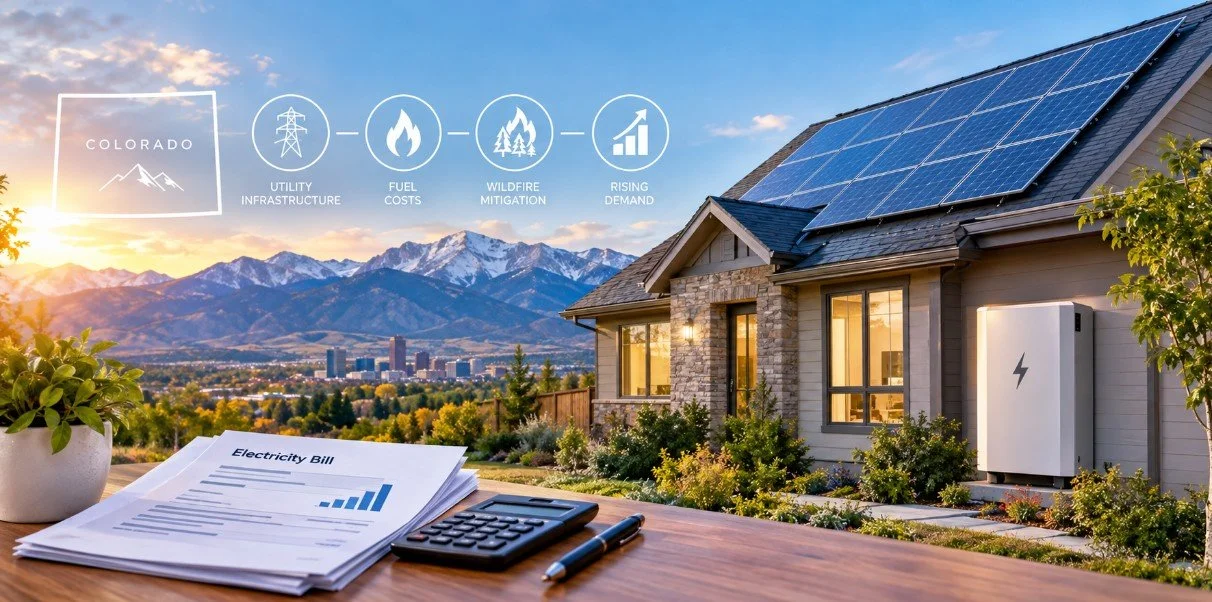
Colorado electricity rates can change because of utility infrastructure investments, fuel costs, wildfire mitigation, and growing demand for power. In 2026, homeowners need to understand which factors may affect their electricity bills and which steps can help them manage household energy use. Energy Advantage Roofing & Solar helps homeowners explore options such as solar energy, battery storage, and home energy efficiency to make informed decisions about their energy needs.
What Is Happening With Colorado Electricity Rates in 2026?
Electricity rates vary by utility, service area, rate plan, and household consumption. A homeowner served by Xcel Energy may have a different rate structure from someone receiving electricity through Colorado Springs Utilities, Black Hills Energy, or a local electric cooperative. Therefore, understanding the rates that apply to your property is the first step towards managing electricity expenses.
Rate changes may reflect approved utility adjustments, infrastructure investments, fuel expenses, and other costs associated with providing reliable electricity. Proposed rate increases should not be confused with changes that regulators have already approved.
Homeowners can start by reviewing:
Current electricity rates: Check the applicable utility tariff and effective date for your service area.
Monthly electricity consumption: Review the kilowatt-hours (kWh) used during each billing period.
Billing structure: Understand fixed charges, usage-based charges, and any applicable time-of-use rates.
Recent rate changes: Compare current bills with earlier statements to identify changes in rates or usage.
Checking these details can help determine whether a higher bill results from increased electricity consumption, a rate adjustment, seasonal demand, or a combination of factors.
Why Are Electricity Rates Changing in Colorado?
Electricity rates reflect the combined costs of generating, transmitting, distributing, and maintaining the power system. Different utilities face different operating conditions, so the reasons for a rate adjustment can vary across Colorado.
Utility Infrastructure and Grid Modernisation
Electricity providers need to maintain power lines, substations, transformers, and other equipment to deliver electricity safely and reliably. Expanding or upgrading this infrastructure can require significant investment. Depending on regulatory approval and the utility's rate structure, some of these expenses may affect customer bills.
Grid improvements can also support growing communities and changing electricity needs. However, not every infrastructure project leads to an immediate or identical increase for every customer.
Homeowners can better understand these developments by:
Reviewing utility announcements about infrastructure projects.
Checking Colorado Public Utilities Commission filings where applicable.
Looking for explanations of approved rate adjustments.
Comparing changes in electricity rates with changes in household usage.
Wildfire Mitigation and Transmission Expansion
Wildfire prevention has become an important consideration for electricity providers operating in areas exposed to wildfire risks. Utilities may invest in equipment inspections, vegetation management, monitoring systems, and other protective measures. Transmission expansion may also be needed to connect generation resources and move electricity across the grid.
These projects can influence utility spending, although the effect on residential rates depends on the specific project, regulatory decisions, and cost-recovery arrangements. Homeowners should rely on utility filings and official announcements rather than assuming that every wildfire-related expense is passed directly to customers.
Fuel Costs and Electricity Generation
Natural gas is used to generate electricity in many parts of the United States. Changes in fuel prices can influence wholesale electricity markets and utility operating expenses, depending on how power is generated and purchased.
Weather conditions, infrastructure constraints, electricity demand, and the availability of different generation sources can also affect market conditions. International oil-market disruptions may influence gasoline and diesel prices, but they do not automatically cause a corresponding increase in Colorado electricity rates.
Understanding these distinctions helps homeowners separate different energy-market developments instead of treating every increase in household energy expenses as having the same cause.
Could AI Data Centres Increase Colorado Electricity Rates?
AI data centres use substantial amounts of electricity to operate servers, cooling equipment, networking systems, and supporting infrastructure. As demand for computing grows, new data centres may require additional generation capacity, substations, and transmission infrastructure.
These developments could put pressure on electricity systems where demand grows faster than available capacity. However, the actual effect on Colorado homeowners depends on project locations, utility planning, infrastructure costs, regulatory safeguards, and how expenses are allocated among customers.
Data centres are not the sole explanation for electricity rate changes. Existing infrastructure requirements, fuel costs, wildfire mitigation, and other utility expenses can also contribute.
Colorado homeowners can follow this issue by:
Checking Colorado Public Utilities Commission proceedings concerning large electricity customers.
Reviewing utility plans for new generation and transmission capacity.
Looking for rules governing how infrastructure costs are assigned.
Following credible local reporting about proposed data-centre developments.
The important question is not simply how much electricity data centres use, but also how their electricity needs are planned and who is responsible for the associated infrastructure costs.
How Do Rising Electricity Rates Affect Colorado Homeowners?
When electricity rates rise, households may pay more for the same amount of electricity. Bills can also increase when homeowners use more power because of heating, cooling, appliances, electric vehicles, or changes in household routines.
The distinction between electricity rates and electricity consumption is important. A household can experience a higher bill even when its usage remains stable if the applicable charges change. Likewise, a household that increases its consumption may pay more even if rates remain unchanged.
To understand a bill more clearly, homeowners should:
Compare monthly kWh consumption with the same period in previous years.
Review the rate plan and any time-of-use periods.
Check whether fixed charges or other line items have changed.
Identify appliances or systems that contribute to higher usage.
Consider seasonal factors such as air conditioning and electric heating.
These steps provide a more useful starting point than looking at the final bill total alone. They can also reveal opportunities to reduce unnecessary consumption before investing in new equipment.
Will Colorado Electricity Prices Keep Increasing Through 2030?
Future electricity prices will depend on several factors, including utility investment plans, fuel markets, electricity demand, regulatory decisions, and the cost of maintaining the grid. Electrification may also influence demand as more households adopt electric vehicles, heat pumps, and other electric technologies.
At the same time, changes in generation resources, energy efficiency, and electricity system planning can influence how utilities meet demand. These competing factors make it difficult to predict a precise rate increase for every Colorado household.
Homeowners can prepare for uncertainty without assuming that prices will follow a fixed upward path. Useful steps include:
Monitoring official utility rate announcements and approved filings.
Reviewing electricity consumption throughout the year.
Improving insulation, air sealing, and heating and cooling efficiency.
Comparing available rate plans when the utility offers alternatives.
Evaluating whether solar generation could suit the property's energy needs.
Any numerical forecast for 2030 should be supported by a dated, credible source and clearly identified as a projection rather than a confirmed future rate.
What Can Colorado Homeowners Do About Rising Electricity Costs?
Homeowners cannot control utility rate cases, fuel markets, or decisions made by the Federal Reserve. However, they can take practical steps to understand their consumption and reduce avoidable electricity use. The most suitable approach depends on the property's condition, household routines, utility plan, and long-term energy requirements.
Improve Home Energy Efficiency
Energy efficiency improvements can reduce the amount of electricity required to maintain comfortable indoor temperatures and operate household equipment. Simple changes may also help homeowners identify waste before considering larger upgrades.
Useful measures include:
Sealing air leaks around doors, windows, and other openings.
Improving insulation where appropriate.
Using efficient lighting and appliances.
Maintaining heating and cooling equipment.
Adjusting thermostat settings to suit household needs.
Tracking electricity consumption to identify unusual increases.
The potential benefit varies by property, climate conditions, equipment, and existing efficiency levels. A home energy assessment can help prioritise improvements that address the largest sources of energy waste.
Consider Solar Energy
Solar panels allow homeowners to generate electricity at their properties and potentially reduce the amount purchased from the grid. The results depend on roof orientation, shading, system size, household consumption, local utility rules, and the value assigned to exported electricity.
Homeowners researching solar installers in Denver should compare system designs, equipment specifications, installer qualifications, warranties, and projected production. They should also understand how the utility credits excess electricity and whether the proposed system matches their actual energy use.
Solar does not eliminate every electricity charge, and savings are not guaranteed to be the same for every property. A reliable assessment should use realistic production estimates, applicable utility tariffs, and the household's electricity consumption history.
Understand the Role of Battery Storage
Battery storage can hold electricity generated by solar panels for use later, such as during evening hours when solar production falls. Depending on system design and utility rules, a battery may help a household use more of its own generated electricity and may provide backup power when configured for that purpose.
Before comparing battery storage installation cost, homeowners should consider battery capacity, usable energy, power output, installation requirements, warranty coverage, and backup-power needs. They should also check whether the battery is compatible with the proposed solar system and whether the expected benefits justify the investment.
Battery storage does not automatically reduce every bill. Its financial value depends on electricity rates, export compensation, usage patterns, system efficiency, and any applicable incentives or programme requirements.
Review Household Electricity Usage
Monitoring electricity consumption helps homeowners understand when and how they use power. This is particularly useful for households with electric heating, cooling equipment, electric vehicles, or other high-consumption appliances.
Reviewing usage patterns can help identify opportunities to shift flexible activities to lower-rate periods where time-of-use pricing is available. Homeowners should confirm the conditions of their own utility plan before changing their routines.
Is Solar Worth Considering as Electricity Rates Change?
Solar may be worth evaluating for homeowners who use substantial amounts of electricity during daylight hours or can benefit from storing solar generation for later use. However, the decision should be based on the property's circumstances rather than the assumption that electricity rates will continually increase.
When comparing solar panel installers, ask for an assessment that considers:
Recent electricity bills and annual household consumption.
Estimated solar production throughout the year.
Roof condition, orientation, and shading.
Utility rules for exported electricity and grid connection.
Equipment warranties, maintenance, and system performance.
Financing terms and the total expected ownership costs.
Whether battery storage would provide additional value.
A useful proposal should explain its assumptions and distinguish estimated savings from guaranteed outcomes. Homeowners should also account for any ongoing utility charges that remain after installing solar.
Solar primarily reduces exposure to purchased electricity. It does not directly protect a household from gasoline prices, natural gas prices, or changes in interest rates. Battery storage may improve the ability to use self-generated electricity, but its value depends on the system and household requirements.
Take Control of Your Home’s Energy Future
Colorado electricity rates depend on a combination of utility investments, generation costs, infrastructure needs, and changing electricity demand. Homeowners can respond by monitoring their bills, improving energy efficiency, and evaluating whether solar panels or battery storage suit their properties. Understanding the applicable utility rules and household consumption patterns is essential before making an investment.
Energy Advantage Roofing & Solar can help homeowners explore solar and related energy solutions based on their property's requirements. Contact us today to discuss your home's energy needs and determine which options may be worth considering.